 BONECALLER
Game Design
The Bone Forge: Turn a Collection into a Chosen Direction
Bonecaller's Forge connects recruitment to commitment. See why choosing a target, a role, and a sacrifice can make developing an army feel purposeful.
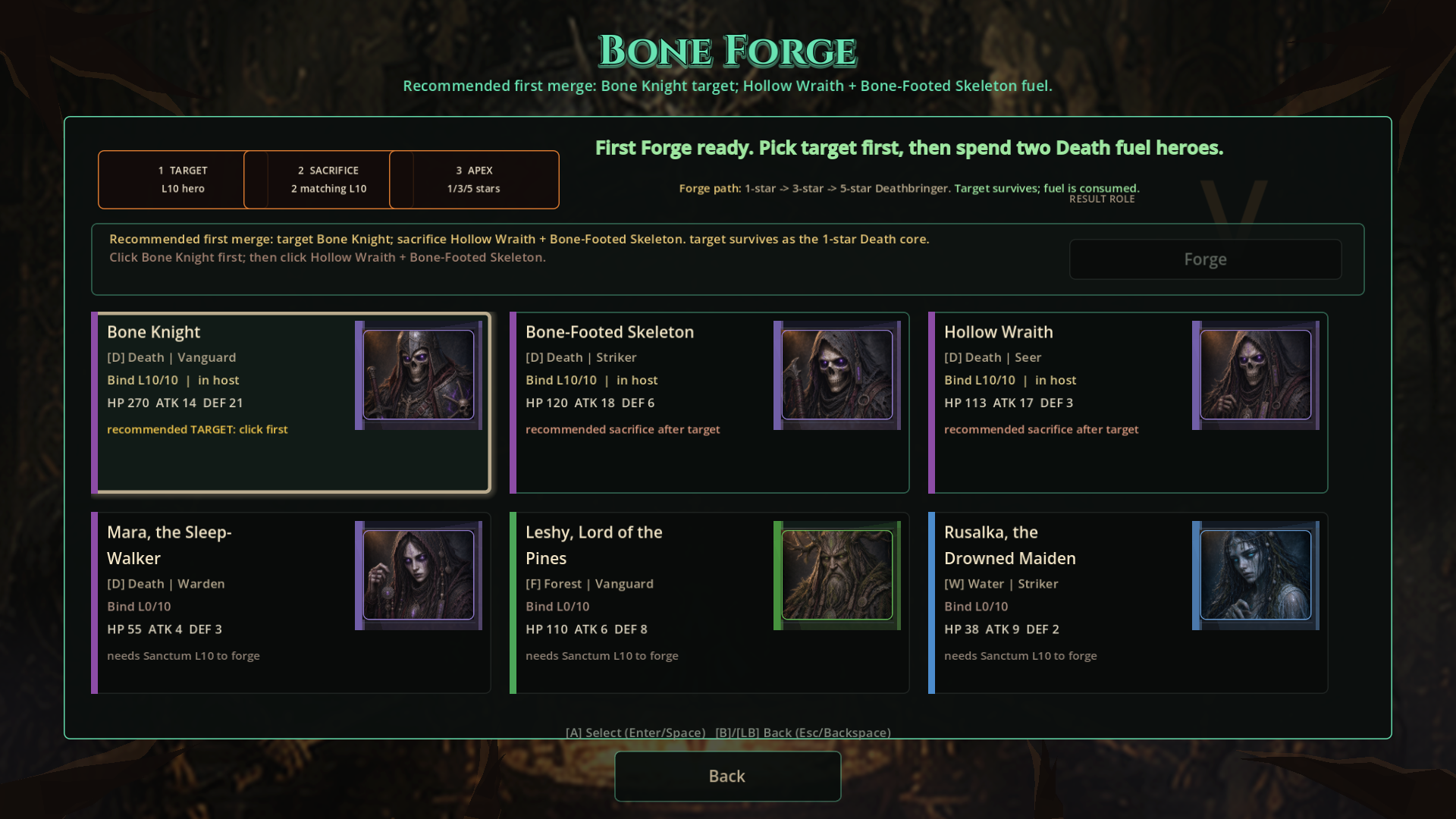
A collection gives you possibilities. A forge asks which possibility deserves a commitment. In Bonecaller, the Bone Forge turns compatible heroes into a more developed chosen target, consuming the source heroes along the way. It gives the necromancer fantasy a concrete decision: what should this gathered power become?
For a prospective player, that is the interesting part of the system. You do not need to learn a recipe to understand its appeal. The Forge connects recruitment to intention, making the army something you shape from what the descent provides.
Gathering and choosing are separate pleasures
Raising a new creature can feel like an expansion of possibility. It adds another portrait to the collection and perhaps another role or affinity to consider. A broad roster is valuable because it lets you imagine more than one future team.
The Forge moves in the opposite direction: several compatible investments become a more concentrated result. You select a target and provide matching sources. The target advances while the sources are consumed.
That creates a deliberate exchange between breadth and development. The collection does not simply grow in every direction at once. Some pieces become the means of strengthening a chosen core.
This exchange is central to deciding whether the system appeals. If you enjoy turning gathered material into a defined result, it can make ordinary collection progress feel purposeful. If keeping every creature untouched is your priority, consumption is a meaningful part of the design to consider.
The result has a job, not only more power
Forge development increases a hero's strength, but the role choice also shapes what that strength is for. Vanguard emphasizes health and defense. Striker emphasizes attack. Warden favors a durable profile, while Seer emphasizes speed and critical pressure with lighter defenses.
The available roles depend on affinity, so the system has boundaries. Within those boundaries, the choice connects a developing hero to the formation you want to build.
That can make two superficially similar goals feel different. Wanting a stronger attacker is a distinct intention from wanting an anchor that protects the rest of the Host. Both concern power, but they place that power in different relationships.
The Forge therefore gives a player a question worth answering before the transformation: what does the army need this hero to become? The answer is more specific than “the next upgrade.”
Development changes a hero's team contribution
Forged heroes also contribute more affinity points as they develop. Affinity thresholds activate shared bonuses, such as Death's lifesteal or Forest's damage reduction. A developed hero can therefore help carry a team effect as well as improve its own stats.
This creates an interesting connection between an individual investment and the wider formation. A stronger affinity anchor can give you more freedom to consider other members of the Host.
There is a long-term form called an apex at the end of the ordinary Forge progression. Its importance here is that it concentrates an affinity's contribution in a highly developed hero. You can understand that design purpose without revealing every apex or planning the entire route to one.
For a player who likes seeing a build take shape, this is a reason the Forge may be compelling. A single development goal can alter how you think about several team slots.
A transformation is also a trade-off
Because source heroes are consumed, the Forge is not merely a reward animation attached to a number. It affects the roster that remains available. The game presents a preview so that the result and its cost can be considered before commitment.
That supports a particular kind of play: looking ahead. The army you want later and the army you can field now are related, and developing one part of the collection can change the options elsewhere.
The interesting choice depends on the collection and the intended formation. A hero can be valuable for its place in the current Host or for what it helps a target become. Holding those two possibilities together gives the transformation something to think about.
Consequences can make a choice satisfying, but they also ask for attention. If your preferred collection game should require very little comparison or planning, this is a system to inspect carefully.
Why the fantasy and the rule fit together
The name Bone Forge suggests that the dead are material for another form of power. The actual system follows that idea: raised creatures feed a deliberate transformation, and the result returns to the Host with a chosen purpose.
That alignment gives the theme more work to do than decorating an upgrade menu. Recruitment, sacrifice, and formation become parts of one understandable fantasy.
The compatibility rules give that imagination a structure. You are working with a particular collection toward a particular result, so progress can make the intended transformation easier to picture. The army's next direction begins to take shape before the rite itself.
See the Bone Forge in Bonecaller's gameplay. It is where the creatures gathered during the descent become material for a more deliberate idea: a stronger core, a different role, and another shape for the Host.
Game details reflect the September 15, 2026 alpha. See current release information.