 BONECALLER
Army & Strategy
Why free boss practice makes room for curiosity
Bonecaller's free practice lets an army idea become a comparison before a reward attempt. See what that offers players who enjoy testing their own plans.
There is a small but important difference between wondering whether a strange formation could work and being willing to spend a limited attempt finding out. A game can invite experimentation in its description while making the experiment feel expensive in practice. Bonecaller's free boss practice addresses that tension directly: you can examine how your current army performs without consuming a reward attempt.
For a prospective player, this feature says something about the kind of thinking the game makes room for. You do not need to know the names of every hero or understand the late-game economy to recognize the appeal. An idea can become a comparison before it becomes a commitment.
Curiosity needs a place to go
An unusual team is easy to dismiss when the only visible question is whether it produces the largest possible reward right now. A safer, familiar option can seem sensible even when another arrangement might teach you more.
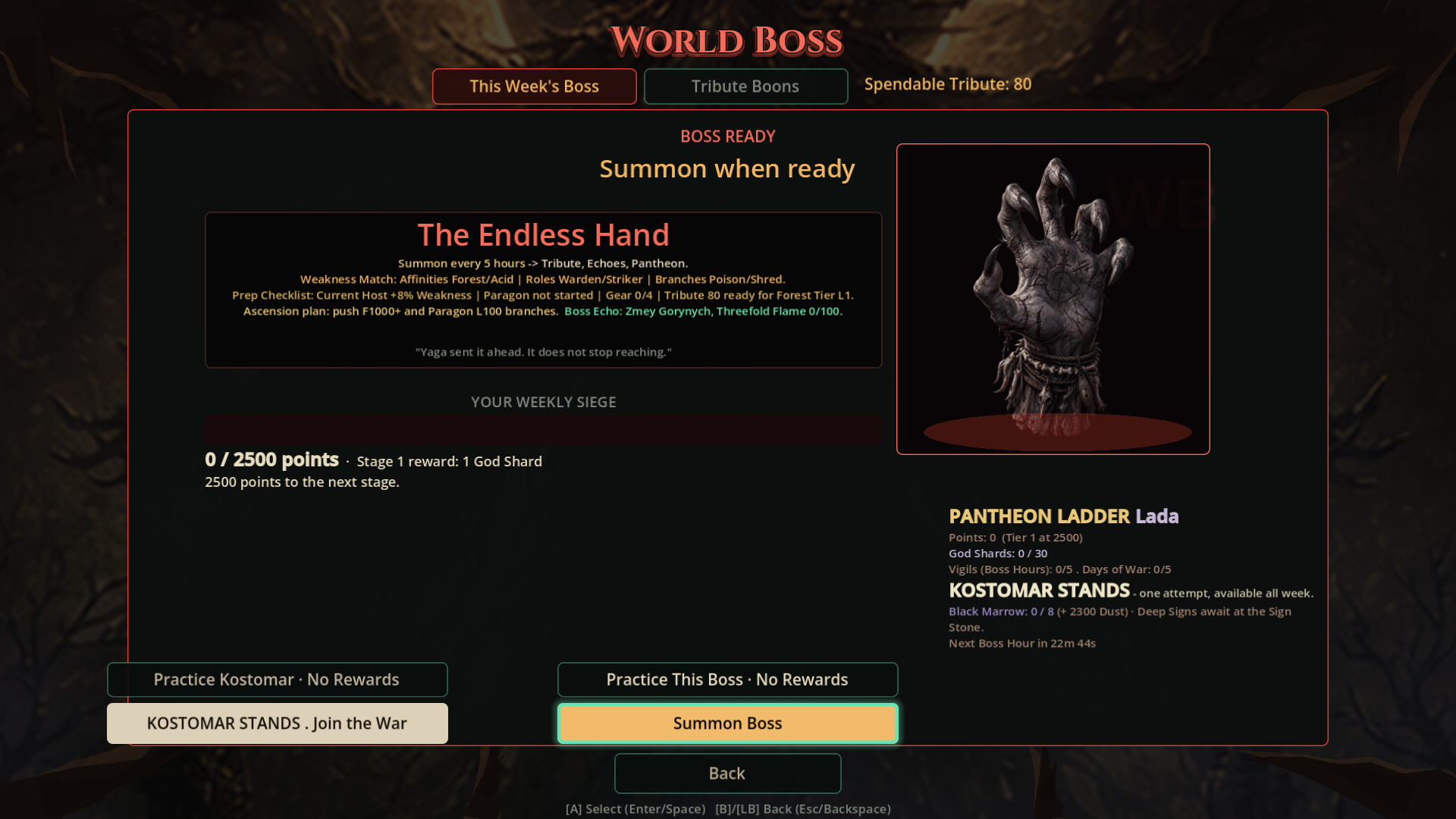
Practice changes that immediate decision. In Bonecaller's current alpha, both the rotating weekly boss and Kostomar have practice options. Each runs twelve trial battles with the current Host and summarizes damage, including the minimum, mean, and best result. It also provides reward estimates.
These battles consume no attempt, start no cooldown, and spend no resource. They also grant no rewards. Their purpose is information.
That separation is useful because it lets “I want to find out” be a sufficient reason to try something. The experimental formation does not have to justify itself as the safest reward choice before you can see how it behaves.
A range tells a different story from one exciting number
Imagine two hypothetical armies. One produces an impressive best result but has much weaker runs. Another peaks lower yet stays closer to its usual output. Which would you prefer?
You might enjoy the dramatic possibility of the first or value the predictability of the second. Seeing both the peaks and the lower results makes that preference actionable. The report helps you decide which kind of performance you want from this army.
Bonecaller's report makes more than the high point visible. A mean summarizes the trial set, while the low and high results show something about its spread. You can see whether a promising average comes with fairly similar results or a much wider range.
The trials are repeatable, which makes comparisons more useful than simply celebrating whichever run happened to look most spectacular. They still do not make a live encounter certain. Changes to the build or different battle rolls can change the result.
For someone who likes testing ideas, that is a healthy kind of uncertainty: there is evidence to consider, but still a reason to interpret it.
The interesting comparison is a question about play
You do not need to turn a game into a spreadsheet to appreciate a practice room. The question can be as simple as whether adding a sturdier ally allows a favorite attacker to contribute more.
Bonecaller gives that question a concrete setting. Front and back positions influence exposure. Roles emphasize different strengths. Affinities create team effects. Moving from one arrangement to another can therefore change how the same general collection performs.
The satisfying moment, if this style suits you, is recognizing a relationship. A hero's personal damage might matter less than the extra time it gives the rest of the Host. A fast but fragile plan might look excellent against one boss and less persuasive against another.
Practice does not declare the player's preferred answer. It gives that preference something observable to work with. Wanting a more reliable formation and wanting a more explosive one are different goals, even when both players care about winning.
A place to test the army you have earned
Practice uses your current Host, so its comparisons concern creatures and power you have developed. Running the trial is free. Building that army involves earned resources, and the Bone Forge consumes source heroes when it transforms a target.
That connection gives the experiment a history. A recruit you wanted to try can finally enter a comparison. A newly learned Sign can change the preparation. The trial gives those additions a first question to answer before a reward-bearing encounter.
The collection and the testing support each other: developing heroes creates possibilities, and examining those possibilities can suggest another direction for development. A result can leave you interested in the next change as much as the next reward.
A useful feature to look for before choosing
If you enjoy refining builds, a prospective game's willingness to show its workings matters. Can you make a comparison? Can you see more than a success animation? Does learning consume the same scarce opportunity as claiming a reward?
Bonecaller's practice mode offers a concrete answer to those questions. It gives the curious player a repeatable comparison, a visible report, and the freedom to keep the reward attempt for later. An unfamiliar combination can be worth examining simply because you want to understand it.
The best next step is to look at Bonecaller's gameplay and decide whether its army-building decisions interest you. A place to test an idea becomes valuable when the idea itself makes you curious.
Game details reflect the September 15, 2026 alpha. See current release information.