 BONECALLER
Progression & Collection
Signs that stay learned: progress with room to change
Bonecaller's learned Signs stay with a hero when another is selected. Discover the appeal of building lasting options as well as increasing combat power.
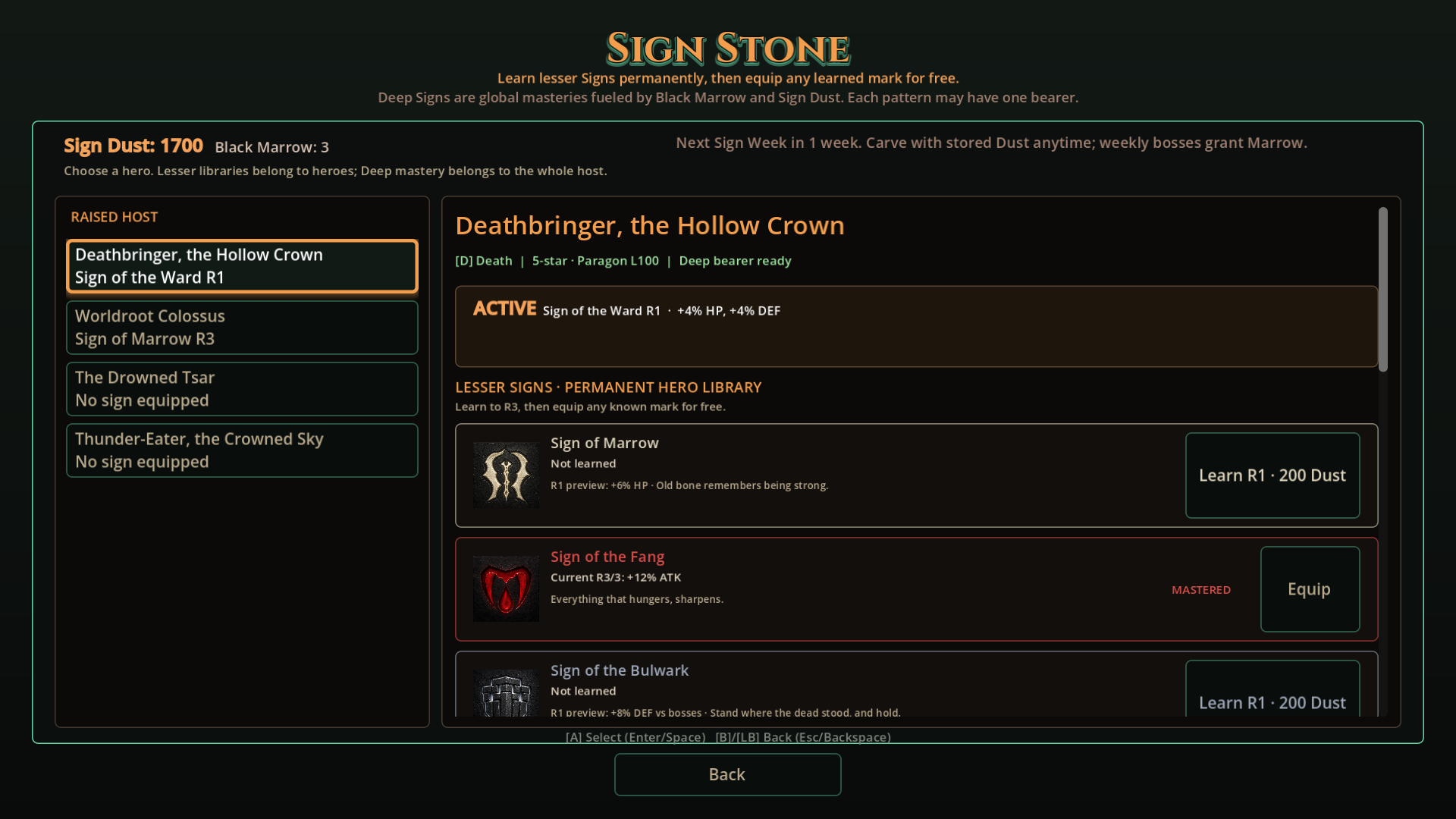
A character can become stronger in two different senses. Its active numbers can rise, or its range of useful options can grow. Bonecaller's lesser Signs offer a version of the second kind of progress: once a hero learns a Sign rank, that knowledge stays with the hero even when a different learned Sign is selected.
That distinction is easy to miss in a list of features. For someone considering the game, it helps answer a more personal question: do you want to build a single finished configuration, or do you enjoy developing a character who can answer different situations over time?
Permanent learning does not mean a permanent selection
Signs are patterns attached to heroes. The lesser library includes options that emphasize health, attack, speed, defense, critical chance, and resource output. Learning and improving a pattern costs an earned resource called Sign Dust.
The useful detail is what happens afterward. Equipping another lesser Sign the hero already knows is free. The first pattern remains learned at its purchased rank. You are selecting from knowledge you have built, rather than destroying one investment to make room for the next.
This does not mean all of those benefits operate together. The selected Sign supplies the active effect. A wider library increases the options available when making that selection; it does not quietly grant every learned bonus at once.
For a prospective player, that is the central idea to understand. The collection on a hero can deepen without every new discovery making the previous one obsolete.
A hero can have more than one useful job
Take a simple imagined example. You have developed a hero you like and taught it both Fang, an attack pattern, and Marrow, a health pattern. One emphasizes hitting harder; the other gives that bearer more health.
The interesting choice is contextual. A battle in which the hero survives comfortably makes extra damage worth considering. An encounter that puts more pressure on the same bearer gives you a reason to revisit its health. You are adapting a familiar character to the job you want it to do.
Because both patterns remain learned, changing your mind about the active one need not erase the work behind the other. Your growing familiarity with the hero can matter alongside its growing collection of options.
There is a quiet satisfaction in that kind of development. A familiar creature can gain new uses as your priorities change. The favorite you have already invested in becomes the starting point for another idea, carrying its learned options into the next decision.
The library has different kinds of value
Not every Sign is simply another way to increase a combat statistic. Some affect the bearer in battle, while Harvest and Vigil concern account resource output when selected. That creates a distinction between immediate fighting strength and the broader process of developing the collection.
There is no need to memorize the full library before deciding whether Bonecaller interests you. What matters is recognizing that these choices have different purposes. A useful option can be one that fits the current activity, rather than the one with the most dramatic name or largest-looking number.
This is also why “permanent” needs a precise explanation in any progression game. A permanent unlock, a permanently selected effect, and an effect that is always active are three different things. In the lesser Sign system, the lasting part is the learned rank. The active selection can change.
That clarity gives you a better basis for judging the game than a vague promise of permanent power.
Keeping progress can soften the cost of learning
Many people hesitate to explore a system when the first choice feels like an exam they must pass before understanding the rules. A retained library can reduce one part of that pressure. A pattern that is not your current favorite can still remain available for another situation.
It does not remove the cost of acquiring it. Sign Dust must be earned, and learning more patterns competes with improving existing ones. The system still asks where to invest. It simply preserves the learned result when you later select something else.
Deep Signs, a later system, follow a related but distinct rule: their mastery belongs to the account and can move between eligible bearers. They are not a second name for lesser Signs, and they have additional requirements. The shared appeal is lasting development that does not vanish merely because a different option becomes active.
What this tells you about the game's fit
A growing library gives the planner something useful to keep in reserve. A speed pattern, a defensive option, and an attack pattern represent different ways for the same hero to contribute. Each learned rank adds an option you can return to when the army's needs change.
Bonecaller pairs automatic battles with decisions about the army that enters them. Signs add another place for those decisions to live. You are not timing a defensive spell in the middle of an attack; you are choosing what preparation the hero carries into the fight.
To see whether that kind of authorship appeals, watch the actual game. The important question is whether you want to keep learning what your army can become, one lasting option at a time.
Game details reflect the September 15, 2026 alpha. See current release information.