 BONECALLER
Game Design
What Is an Idle Auto-Battler, and Where Do Your Choices Matter?
Automatic attacks still leave room for meaningful decisions. See how team composition, development, and offline progress divide the work in Bonecaller.
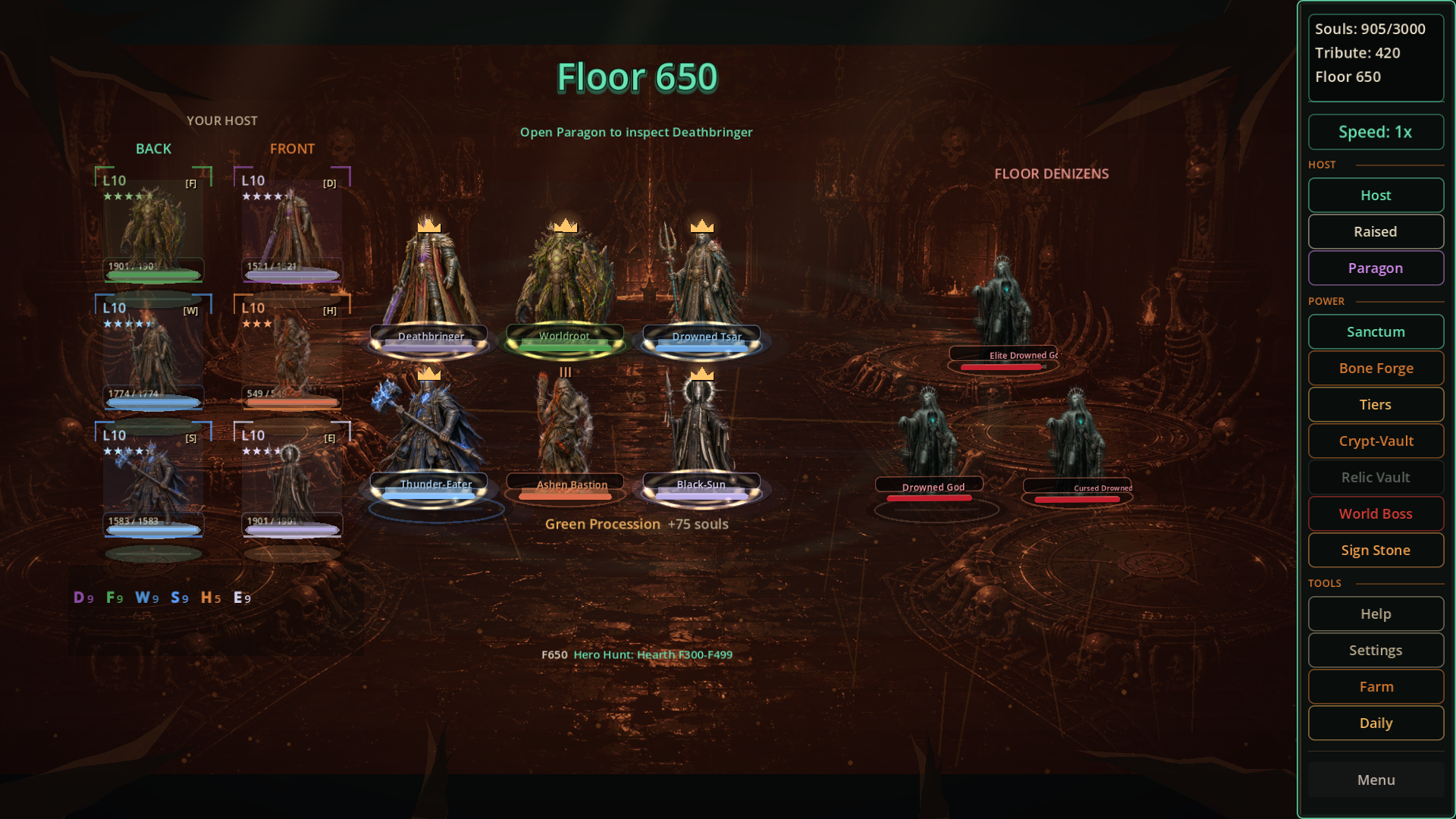
An idle auto-battler gives the computer two jobs a player might otherwise do: execute routine combat actions and, within limits, keep some progress moving between visits. The interesting part is what remains for you. If choosing a team feels meaningful before battle and interpreting the result feels meaningful afterward, automatic attacks can leave plenty to do.
Bonecaller is built around that division. Its undead heroes fight automatically, while you choose their formation, develop their strengths, and decide what the army should attempt. Understanding those separate jobs is more useful than assuming that the word “idle” tells you how much attention the entire game requires.
Three different kinds of action
Consider a battle from three distances. At the closest distance, someone chooses the immediate action: attack now, dodge now, use a skill now. One step back, someone decides which fighters should enter and what support they need. Farther back still, someone decides which fighters to develop for the challenges ahead.
Bonecaller puts its emphasis on the latter two distances. It resolves attacks for you. You choose the Host, its front and back rows, and the development that makes your chosen formation possible.
That arrangement changes what a mistake looks like. A loss may invite a question about the team you brought, rather than whether you pressed a button quickly enough. The response is a new hypothesis: perhaps the front line needs more staying power, or perhaps the army needs a different affinity bonus.
Preparation and observation become a pair. A good idea is something you can put into a formation, and the next battle gives that idea a visible result to understand.
Composition makes a choice visible
In Bonecaller, front-row heroes take more direct pressure. Back-row heroes are less exposed while a front line remains. A durable Vanguard and an attack-focused Striker therefore contribute in different ways even before affinity bonuses enter the picture.
Imagine a prospective formation with several attractive damage dealers and little protection. That is a design example, not a tested recommendation. Adding another attacker might increase its damage potential; adding a Vanguard might give the existing attackers more time to act. Which matters more depends on the encounter and the rest of the build.
The trade-off is the point. Automatic execution can still reveal whether the decision was sound. The player supplied the conditions under which the battle unfolded.
Affinities create another layer. Reaching a Death threshold grants lifesteal, while a Forest threshold reduces incoming damage. A new hero can change both its own contribution and the bonuses available to the team. Its value is partly relational.
Development decides which options exist
A roster is a set of possibilities, but those possibilities need investment. Bonecaller lets you bind heroes to improve their basic stats and use the Bone Forge to develop compatible heroes into stronger forms.
Forge choices also involve a role. A hero developed toward attack and one developed toward survival express different priorities. Meanwhile, heroes used as Forge sources are consumed, which makes the collection more than an inventory that always grows without trade-offs.
For a new player evaluating the game, there is no need to memorize the recipe. The meaningful question is whether preparing the pieces for a future formation sounds engaging. This is part of the play, not administrative work surrounding an unrelated action game.
“Idle” has a boundary
When closed, Bonecaller simulates battles with the saved team. The outcome depends on that team's actual ability to win, and the simulation stops at decision-heavy boss gates or a defeat. A locked Farm floor repeats instead of continuing the descent.
Those boundaries preserve a role for returning. Time away can provide resources and results, but it cannot make every future decision on your behalf. The next visit can begin with a summary of what happened and a reason to adjust the plan.
There is also a cap on simulated time. Leaving for longer does not create unlimited progress. Anyone looking for an idle game should inspect this sort of rule because it shapes how the game fits a real routine much more directly than the genre label does.
What to look for in footage
When watching an auto-battler, look beyond the absence of manual attacks. Can you identify the front line? Can you see why a particular hero belongs in the team? Does the interface give you enough information to imagine a change after a loss?
You do not have to understand every icon immediately. You are looking for decisions you would want to own. A battle can be visually busy yet offer few appealing choices to you, or visually restrained while making you curious about the formation behind it.
Bonecaller's current alpha puts that loop on screen: gather the creatures, shape the Host, and see what the army can do. See the gameplay for a closer look at the decisions behind the automatic battles.
Game details reflect the September 15, 2026 alpha. See current release information.