 BONECALLER
Discover Bonecaller
What Is Bonecaller? Build an Army from the Enemies You Defeat
Meet Bonecaller, a dark-fantasy idle auto-battler about raising enemies, shaping an undead army, and choosing how that army grows through the descent.
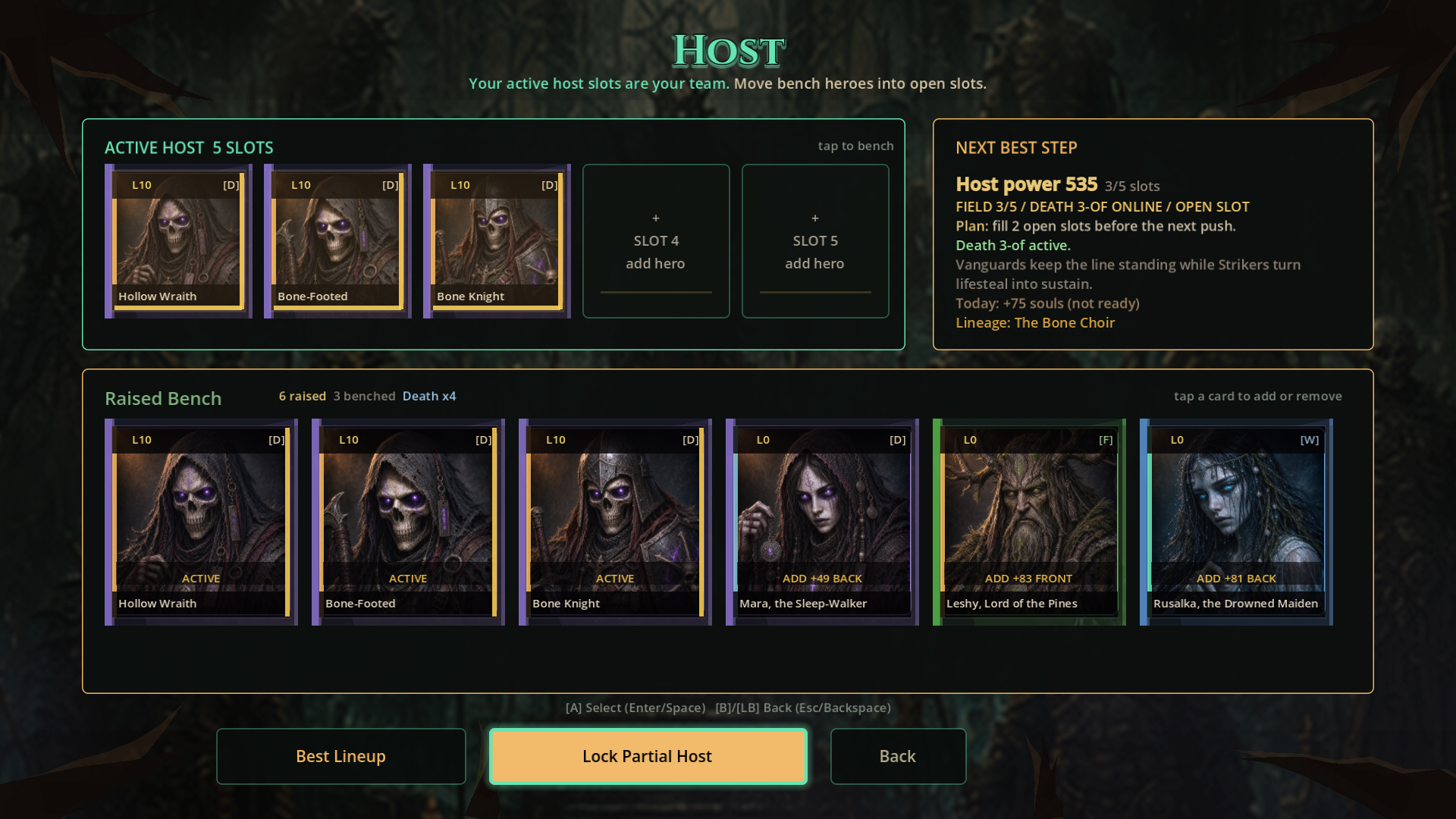
Defeating an enemy usually ends your relationship with it. In Bonecaller, an eligible fallen enemy can become part of your army. That reversal is the game's central promise: explore a hostile world, raise creatures you encounter, and decide what kind of force they will become together.
Bonecaller is a single-player idle auto-battler being developed for Windows PC. You play the necromancer behind an undead Host. Battles resolve automatically; your work is choosing the army, developing its members, and deciding how to approach the next stretch of the descent. The current version is an alpha, so the useful question is whether that experience fits your taste.
Your army is the main character
The opening begins with Hollow Wraith and a single place in the formation. More places open as you progress, eventually allowing a six-hero Host. That gradual expansion gives the army room to acquire a shape. A fragile attacker and a durable protector have different jobs, and adding someone new changes the relationships among the creatures you already have.
The Host is the team you field. Your larger collection holds the other heroes you have raised. Keeping those two ideas separate matters: collecting another creature creates an option, while choosing to deploy it expresses a plan. A larger roster is useful because it gives you more ways to answer a problem, even when every owned hero cannot fight at once.
You are not manually steering six characters around an arena. You arrange a formation and watch the consequences. The appeal lies in recognizing why that formation worked, then deciding what you want to try next.
Enemies can become opportunities
Eligible enemies can leave recruitable heroes behind when defeated. A raise is a chance-based result, not an automatic reward from every kill. The game shows the available hero pool for the current floor, so recruitment has a visible connection to where you fight.
That connection gives exploration two purposes. Moving deeper tests whether your current army can cope, and it introduces possibilities for a different army. A new stretch of the descent can matter even before it offers a stronger item: it may contain the sort of creature your collection is missing.
There is also a deliberate choice between continuing downward and repeating a cleared floor. The latter is the game's Farm mode. For someone considering Bonecaller, the important point is the change of intention. You can be pursuing discovery, or you can be developing the army you want to take into the unknown.
A formation has more than one kind of strength
Heroes have roles and affinities. Roles describe their combat emphasis: a Vanguard supplies a durable front line, while a Striker emphasizes attack. Affinities supply shared bonuses when the formation reaches their thresholds.
Death can support lifesteal. Forest reduces incoming damage. Water slows enemies. These are different ways of helping a team survive and deal damage, rather than interchangeable names for the same bonus. They suggest recognizable preferences: endure the enemy, recover through attacking, or interfere with its pace.
That does not make every combination equally strong. It does mean that the question extends beyond which portrait has the largest attack value. A useful addition may be the hero that lets everyone else do their job.
Later, the Bone Forge develops this idea by consuming compatible heroes to strengthen a chosen target. It also offers role specialization. Your collection becomes something you shape, with decisions about what to preserve, combine, and emphasize.
The game keeps moving between your decisions
Automatic combat removes the need to issue every attack. Offline simulation can also resolve battles using the team and build you saved before leaving. It has limits: it stops at certain boss gates or after a loss, and its simulated time is capped.
That rhythm is important to understand before deciding whether the game interests you. Some progress can happen between visits, but an army that needs a better plan will still need one when you return. Bonecaller leaves team choices and major progression decisions with the player.
You can enjoy the planning without wanting constant clicking. You still need to find satisfaction in reviewing results, making changes, and returning to a longer project. If the pleasure you seek is dodging a final attack yourself, automatic combat may place the action farther away than you prefer.
Who might want to look closer?
Bonecaller's premise is especially relevant if collecting creatures interests you because of what you can build with them. The undead theme gives the collection a purpose, the formation creates constraints, and the descent supplies a reason to reconsider your choices.
It also asks you to be comfortable with repetition and uncertain recruitment. Every battle will not produce a new hero, and every session will not reveal a new system. Developing an army is part of the experience, alongside discovering it.
The journey begins with one creature and opens into an army with a direction of your own. Watch Bonecaller's gameplay to see the Host, its battles, and the choices that turn defeated enemies into the foundation of another descent.
Game details reflect the September 15, 2026 alpha. See current release information.