 BONECALLER
Discover Bonecaller
The Appeal of Playing the Necromancer Behind an Undead Army
Discover Bonecaller's necromancer fantasy: raise eligible enemies, assign creatures a purpose, and shape an army whose strength comes from its formation.
There is a particular appeal to entering a dangerous world as the person who builds the army. Your power is distributed across creatures with different strengths. Victory reflects what you gathered, what you developed, and how you arranged it. The necromancer fantasy makes that relationship unusually direct: the threats you overcome can supply the force that carries you onward.
Bonecaller centers that fantasy. You raise eligible defeated enemies and form an undead Host whose battles resolve automatically. The necromancer's work happens in the choices surrounding those battles, giving players who enjoy assembling a force a different sort of starring role.
Power can look like a formation
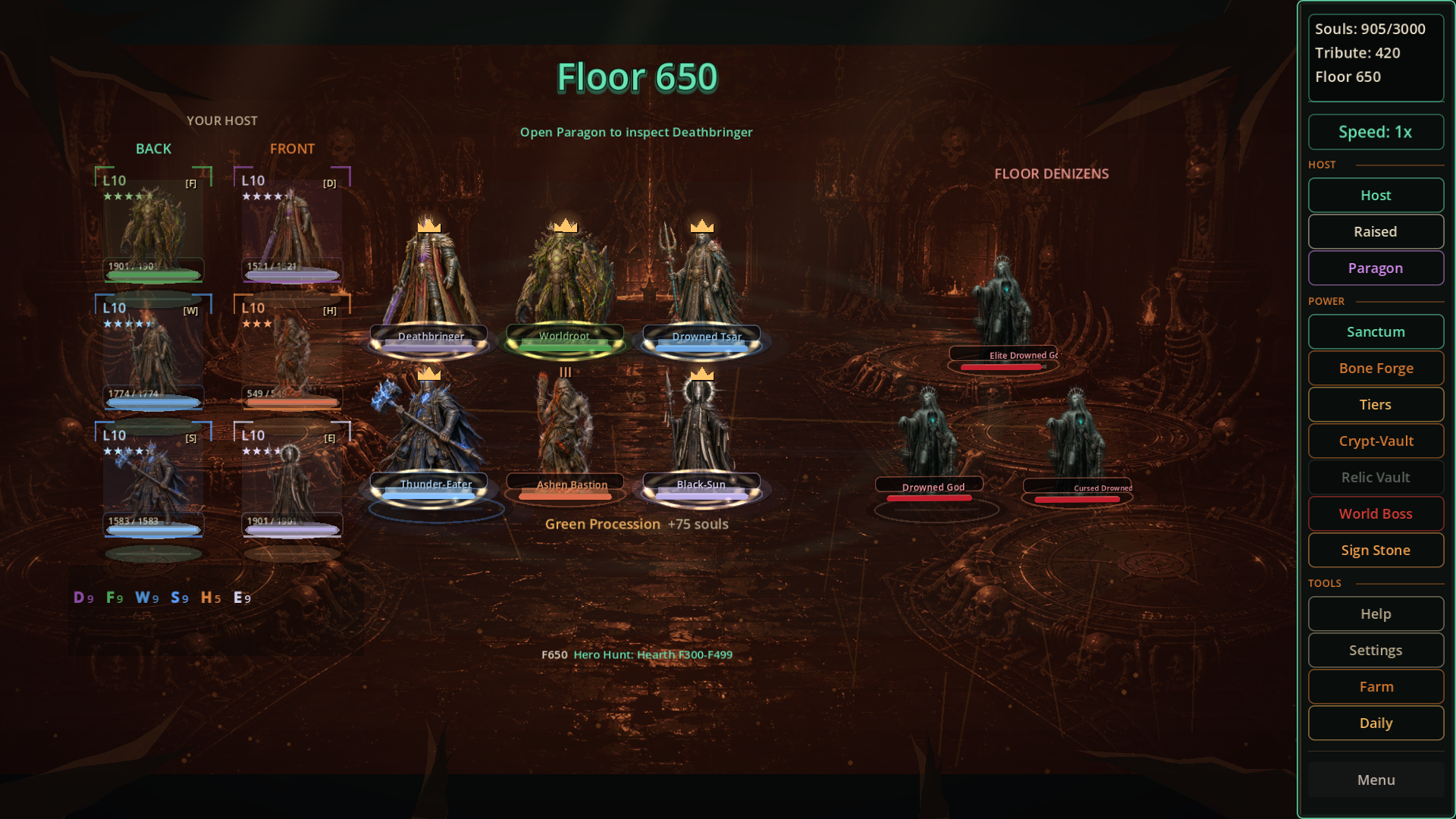
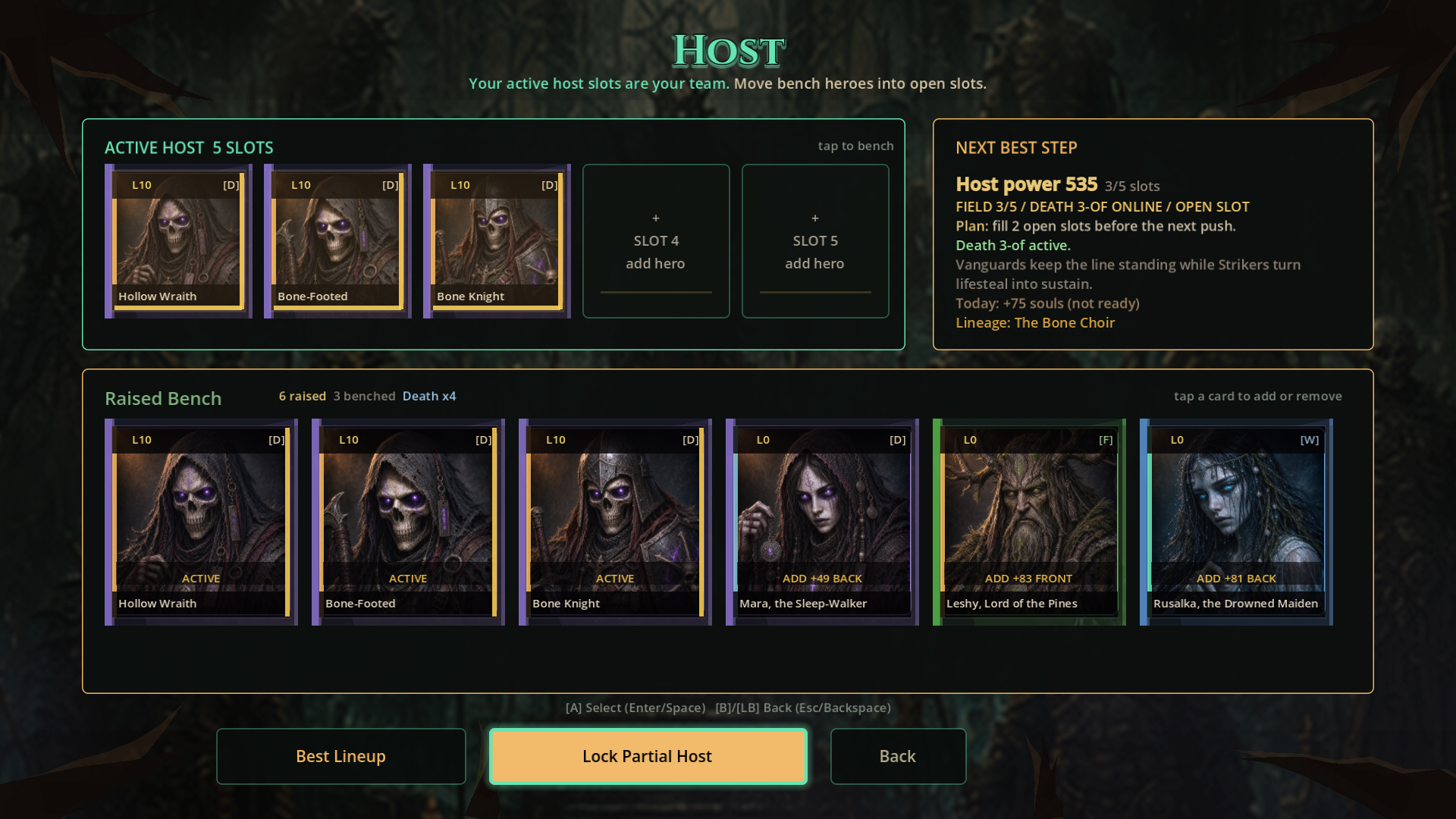
A lone hero can express growth through a larger weapon, a new ability, or a stronger defense. In Bonecaller, growth also changes the shape of the group. An opening built around one Hollow Wraith gradually expands into a formation with more places to fill.
That creates a visible change in responsibility. At first, one creature has to carry the battle. As the Host grows, you can divide the work. A Vanguard can hold the front, a Striker can emphasize damage, and a Seer can bring a faster, more fragile profile.
The result is an army whose strength depends on relationships. You can care about the protector because of the time it creates for another hero, or about a recruit because its affinity brings an important bonus within reach. The necromancer is powerful through the arrangement of those relationships.
For someone drawn to command rather than direct combat, that is a substantial distinction. The formation itself becomes the expression of your choices.
Recruitment changes the meaning of an encounter
The possibility of raising an enemy adds a second thought to combat. A creature is a present obstacle, but it may also represent a future option. That can make encountering something unfamiliar interesting for reasons beyond the reward for defeating it.
Bonecaller makes eligible recruitment pools visible on its battle and Farm screens. You can see a relationship between an area of the descent and the heroes available there. Raises are chance-based, so the possibility of a recruit should not be confused with a promise that the next victory delivers one.
This version of necromancy gives named creatures room to stand out. The active Host eventually holds six heroes, so each place in the formation remains part of your plan even as the broader collection grows.
That limit can make an individual recruit more interesting. A place in the army has a purpose, and another creature must justify why it belongs there.
The forge gives the fantasy a cost
The Bone Forge asks you to commit part of the collection to a chosen hero. Compatible source heroes are consumed as the target develops. You also select a combat role from the options allowed for that affinity.
Thematically, this is a natural extension of building power from the dead. Mechanically, it gives development a consequence. You are deciding which material becomes a stronger core for the army, rather than simply equipping everything that arrives.
A player can find satisfaction in that commitment: several earlier gains become one deliberate result. Another player may dislike consuming creatures they have collected. Both responses are useful signals when deciding whether Bonecaller's version of the fantasy appeals.
The act of transformation gives gathering a destination. Those earlier recruits become part of something you deliberately chose to build, connecting a series of encounters to the army's future shape.
A dark theme with a practical vocabulary
Words such as Host, binding, and Bone Forge establish a necromantic identity. Their jobs are also concrete. The Host is your fielded team. Binding develops a hero's stats. The Forge transforms compatible investments into a more developed hero.
That pairing is valuable for a strategy game. A theme can make a choice feel distinct while the underlying rule remains understandable. The creature you raise is atmospheric, but it also has a role and an affinity you can reason about.
Death, for example, provides lifesteal when its team threshold is met. The name and the effect point in the same thematic direction: damage can help sustain the army. Forest emphasizes damage reduction, suggesting a different sort of resilience. These are authored game mechanics, not statements about folklore.
Decide which part of necromancy attracts you
If your ideal necromancer personally aims spells while a mass of minions follows, Bonecaller's automatic formation battles may feel more distant than you want. If you enjoy choosing the creatures, developing their roles, and seeing an army execute your plan, that distance may be precisely the attraction.
There is also a difference between loving undead imagery and loving an incremental game loop. Bonecaller combines the two. Repeated battles and patient development support the army fantasy; they are part of what you would be choosing.
The Host is the character you build across those encounters, with each member contributing to its power and personality. Meet the army in Bonecaller's gameplay and see how the necromancer's choices take shape on the battlefield.
Game details reflect the September 15, 2026 alpha. See current release information.