 BONECALLER
Game Design
Team-Building Without Commanding Every Attack
Choosing a formation and controlling each attack offer different pleasures. Explore what Bonecaller's automatic battles give you, and where control ends.
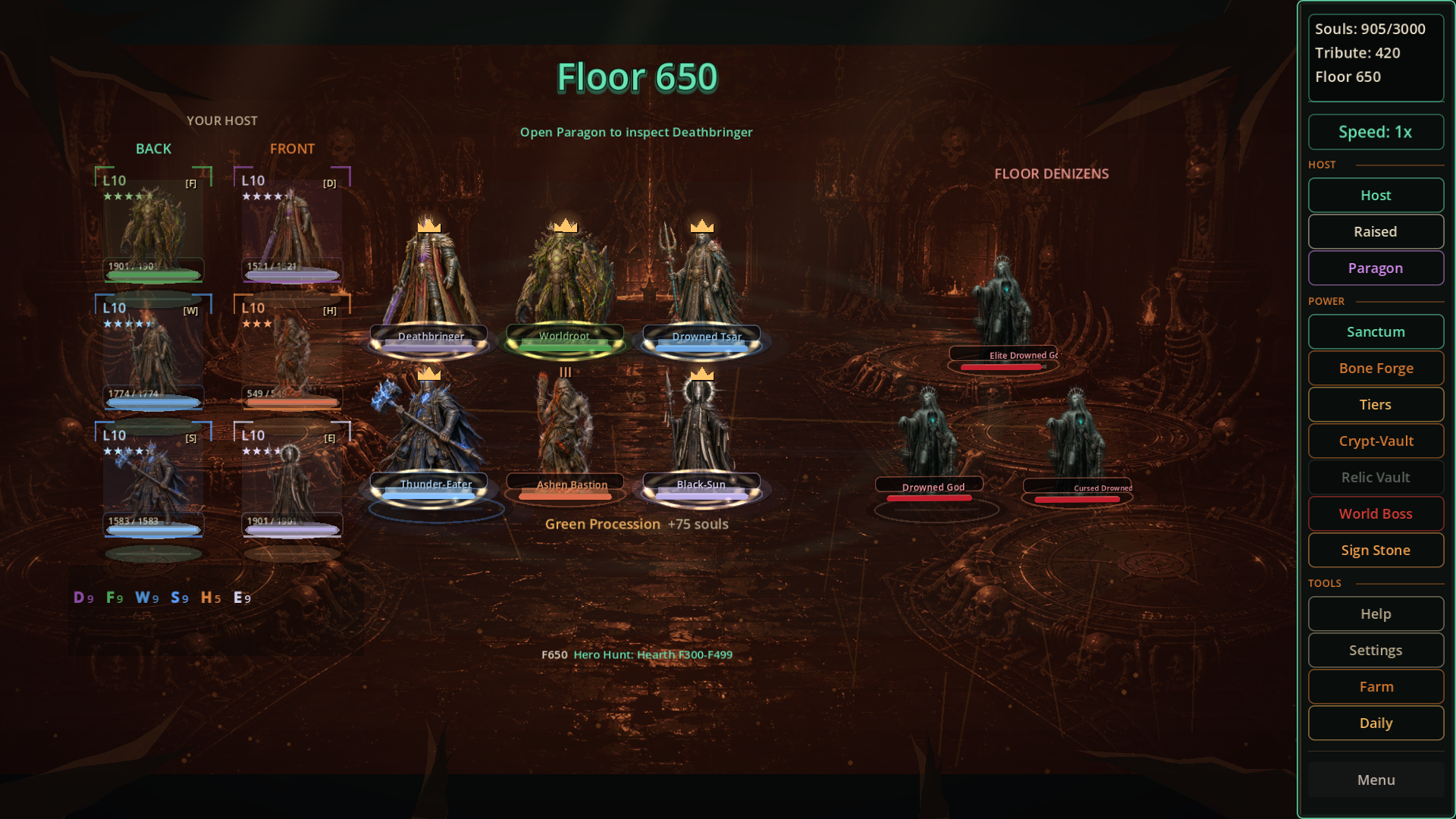
Choosing a team and controlling a team are two different pleasures. The first asks whether the pieces belong together. The second asks what to do with them moment by moment. Bonecaller emphasizes the first: you assemble and develop an undead Host, then let its battles resolve automatically.
That arrangement offers a clear appeal and a clear trade-off. The battle can test your preparation without demanding every attack command, but it also takes some immediate control out of your hands. Understanding both sides helps you decide whether its team-building is the kind you enjoy.
The plan exists before the fight
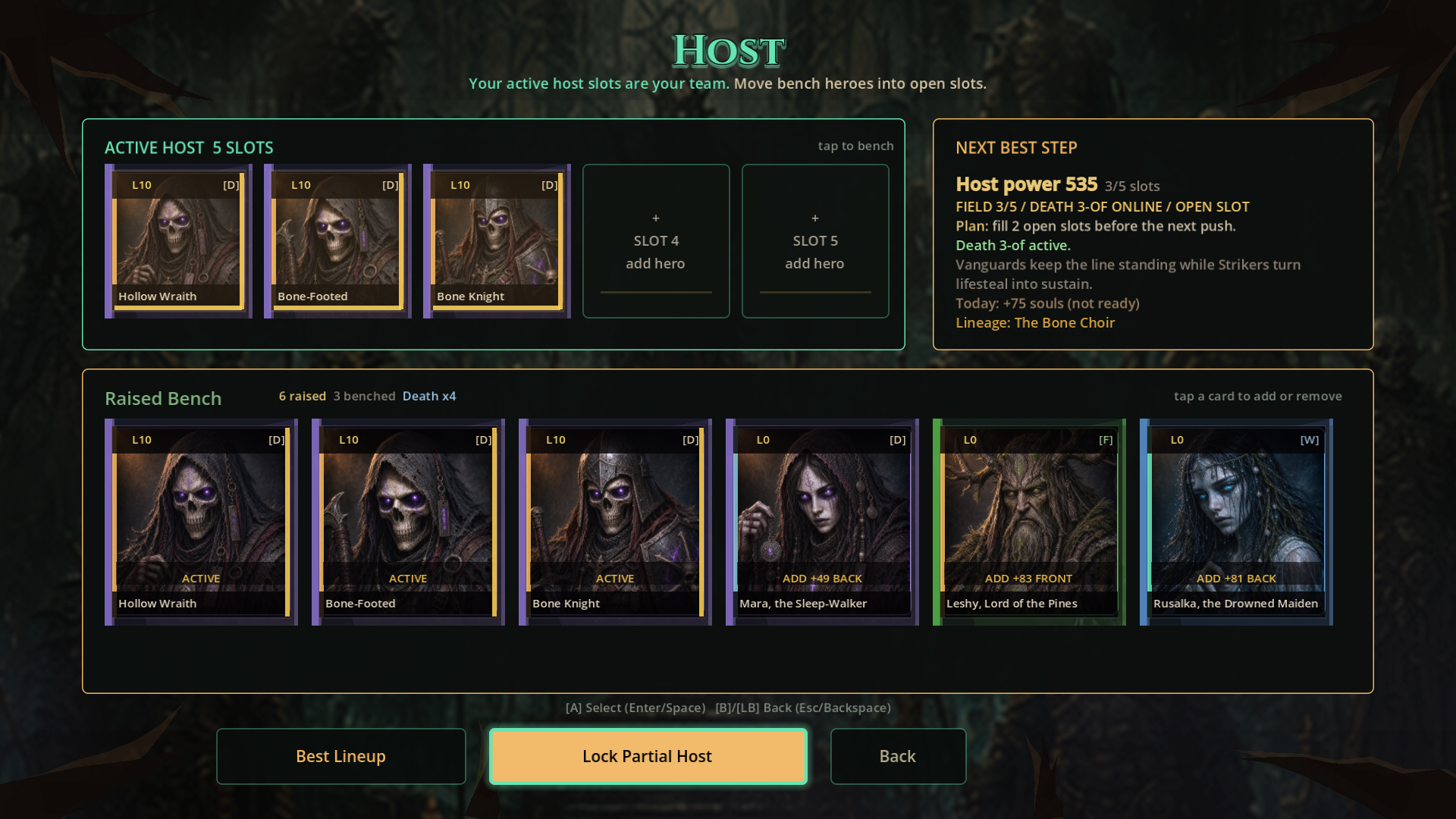
Bonecaller's heroes have roles, affinities, and positions in the formation. These choices establish how the team enters combat. They are the principal language through which you express an intended approach.
A fragile attacker enters a different situation depending on whether a front line protects it. That relationship is established by the army you bring. Once the battle begins resolving, the formation carries the consequences of that choice rather than waiting for you to reposition every attack.
Affinity bonuses establish further conditions before the fight. A bonus that depends on the Host's composition is part of what you prepare, not an emergency button you can press because the battle has taken a bad turn.
This is a form of control through conditions. You decide which strengths the fight begins with, and then the automatic battle reveals how those strengths interact with the enemy.
Your control moves to the next attempt
Imagine watching a formation lose its protection earlier than you expected. In a game built around direct commands, you might want to redirect a unit or manually execute a rescue. Bonecaller's ordinary automatic battles ask you to take that information into the next preparation instead.
You can reconsider which heroes should be fielded, how developed they are, or which shared bonuses the group needs. Those decisions may answer the problem, but they do so at a different moment. Your response is a revised setup for another fight.
That delay can make the result easier to examine. The original plan has run, and you can compare what you hoped it would do with what happened. You are also accepting that the attempted plan must bear some consequences before you redesign it.
Some players enjoy that separation because it gives preparation a clear test. Others find it difficult to watch a problem they cannot immediately correct through manual attacks. Interest in team-building alone does not determine which response you will have.
Execution becomes something you observe
Watching an automatic battle can be active in a different sense from issuing orders. You can notice who is under pressure, whether the formation survives long enough to use its strengths, and where the outcome diverges from your expectation.
That kind of attention can turn a result into information. A victory may suggest the arrangement is adequate for the current task; a loss may point toward a question worth investigating. Neither result needs to be interpreted only as a larger or smaller number.
However, watching does not give you the same immediate rescue tools as direct control. You cannot assume you will personally dodge an attack for a vulnerable hero or improvise a different sequence of moves midway through a routine battle.
This can be freeing if you enjoy the planning most. It can be frustrating if your favorite moments come from overturning a bad situation through execution. The same design choice produces both reactions.
The collection gives planning a longer horizon
Some team decisions involve the heroes already ready to fight. Others involve the heroes you want to develop. Bonecaller's Forge consumes compatible sources to strengthen a target and choose a role specialization.
That means a desired formation can be a longer project. You may recognize what you want before all the pieces are prepared. Recruitment and development become part of assembling the answer.
The distinction matters when evaluating pace. If you prefer instant access to every possible composition, a developing collection may feel restrictive. If building toward a team is itself enjoyable, the restriction can give repeated battles a purpose.
An automatic combat system does not erase that wait. It makes the preparation and the result central, so interest in both is important.
What would make the trade worthwhile for you?
A useful question is whether you enjoy assigning jobs to a group. Perhaps you like identifying a weak link, making a substitution, or finding two effects that complement each other. Those interests point toward Bonecaller's central decisions.
Another useful question is how you react when a plan runs without your intervention. Some players enjoy seeing a setup prove itself. Others immediately want to take over. Neither response needs an argument; it is information about fit.
The current alpha's gameplay footage shows the setting for that decision. Watch the formation as a plan made visible, then consider whether preparing and revising it sounds like time you would want to spend. You can be interested in strategy and still have a strong preference about where your control begins and ends.
Game details reflect the September 15, 2026 alpha. See current release information.